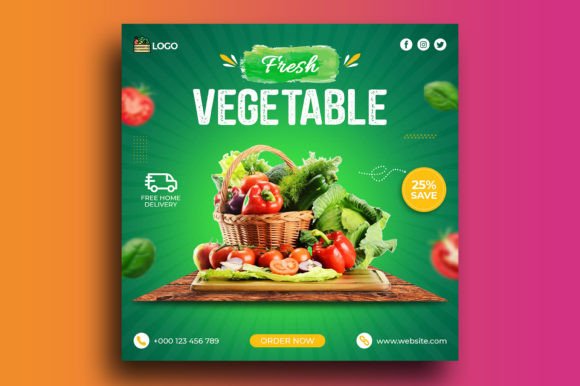
Fresh Healthy Vegetable: Your Go-To Social Media Post Template
Scrolling through a crowded feed, what makes a user stop and actually look at a post? It’s rarely just the text. It’s the immediate visual impact—a clean, professional image paired with crisp, readable typography. For anyone creating content for a health food blog, a local farm stand, a vegan restaurant, or a wellness brand, achieving that polished look consistently can feel like a full-time design job. This is where a smart, ready-to-use template system becomes not just helpful, but essential. The Fresh Healthy Vegetable Social Media Pos template is designed to solve that exact problem, offering a foundation that’s both visually appetizing and incredibly simple to customize.
This isn't a complex design suite requiring months of training. It’s a single, well-structured PSD file built for the realities of small business and content creation. The core appeal lies in its specificity and ease of use. It understands the visual language of freshness—clean lines, vibrant color potential, and a layout that lets your produce or healthy meal take center stage. For the entrepreneur juggling multiple roles, this means less time wrestling with software and more time engaging with your audience.
A Template Built for the Busy Creator
Let's break down what makes this a practical tool rather than just another design asset. First, the technical specifications are immediately useful. At 1080x1080 pixels, it's perfectly sized for Instagram feed posts, one of the most critical platforms for visual marketing. The 300 DPI resolution ensures your graphics look sharp and professional, whether viewed on a high-resolution phone screen or used for a printed flyer. The RGB color mode is standard for digital displays, ensuring the colors you choose translate accurately online.
The true value, however, is in its editability. The template leverages the basics of Adobe Photoshop. You don’t need to be a graphic designer; you just need to know how to use the Text tool to change headlines and body copy, and the Place Embedded function to swap in your own product photos or lifestyle shots. This drastically lowers the barrier to creating consistent, branded content. Imagine being able to generate a week’s worth of cohesive social media posts in under an hour. That’s the efficiency this type of design asset provides.
From Template to Total Brand Identity
While its name suggests social media, the applications of a clean, well-designed template extend far beyond a single Instagram post. Think of this PSD file as a starting point for a broader visual system. The same clean aesthetic and layout logic can be adapted for a variety of marketing materials, creating a unified brand experience for your customers.
Consider these practical uses:
- Menu Design: Use the template’s structure to create a daily specials graphic for your cafe's Facebook page or a clean, image-forward PDF menu.
- Blog Graphics: Generate consistent featured images for your recipe blog or wellness articles, strengthening your site’s visual identity.
- Email Headers: Adapt the layout for a newsletter header to announce a new seasonal menu item or a farm update.
- Promotional Materials: Create simple yet elegant posters for a local farmers' market booth or flyers for a cooking class.
The key is that using a consistent template fosters brand recognition. When your audience sees the same style of image, the same font pairing, and the same color palette across different platforms, it builds trust and makes your business instantly identifiable. This template provides the skeleton; you bring it to life with your unique brand colors, fonts, and imagery.
Making Typography Work for You
A template’s effectiveness often hinges on its typography. The Fresh Healthy Vegetable template likely pairs a strong, readable headline font with a complementary body font. This is a fundamental principle of good design: using font pairing to create hierarchy and guide the viewer’s eye. Your headline should grab attention, while the supporting text should be easy to scan for details.
When you edit the template, consider these points:
- Font Choice Matters: If the included fonts don’t match your brand’s personality, you can change them. A modern, clean sans-serif font conveys efficiency and clarity, perfect for a meal-prep service. A softer, handwritten script might better suit an artisanal bakery. Always ensure any new fonts you install are licensed for commercial use if you’re using them for your business.
- Readability is Non-Negotiable: No matter how beautiful a font is, if your audience can’t read it quickly on a phone screen, it fails. Test your text at the actual size. Avoid overly decorative fonts for body copy. The template’s structure is designed for readability, so maintain that principle when you customize.
- Less is More: Stick to two, maximum three, fonts in a single design. Using the template’s pre-set pairings is a safe bet, but if you change them, ensure the fonts have enough contrast to create visual interest without clashing.
Practical Tips for a Polished Final Product
Getting the most out of a template like this involves a few simple but crucial steps. Before you even open the file, have your content ready. Know your headline, your call-to-action (e.g., “Order Now,” “Recipe in Bio”), and have your best high-resolution photo selected. A stunning photo of fresh vegetables is the hero of this design; the text and layout are its supporting cast.
Once you’ve customized the text and image, do a final review. Zoom out to 100% view—does the text stand out clearly against the background? If you’ve placed a busy photo behind the text, consider using a subtle semi-transparent color overlay or a text box to ensure legibility. Check for typos. Then, save a copy as a PSD file to keep the layers editable for next time, and export your final image as a high-quality JPEG or PNG for uploading.
This approach—using a professional template as a foundation and applying thoughtful customization—is how small teams and solo creators maintain a high standard of visual communication. It’s not about cutting corners; it’s about working smarter. By leveraging a tool designed for the specific needs of health and food-related marketing, you ensure your digital presence is as fresh and appealing as the products you’re sharing.